This article is for educational purposes only and is not medical advice. Always consult a qualified professional about your health.
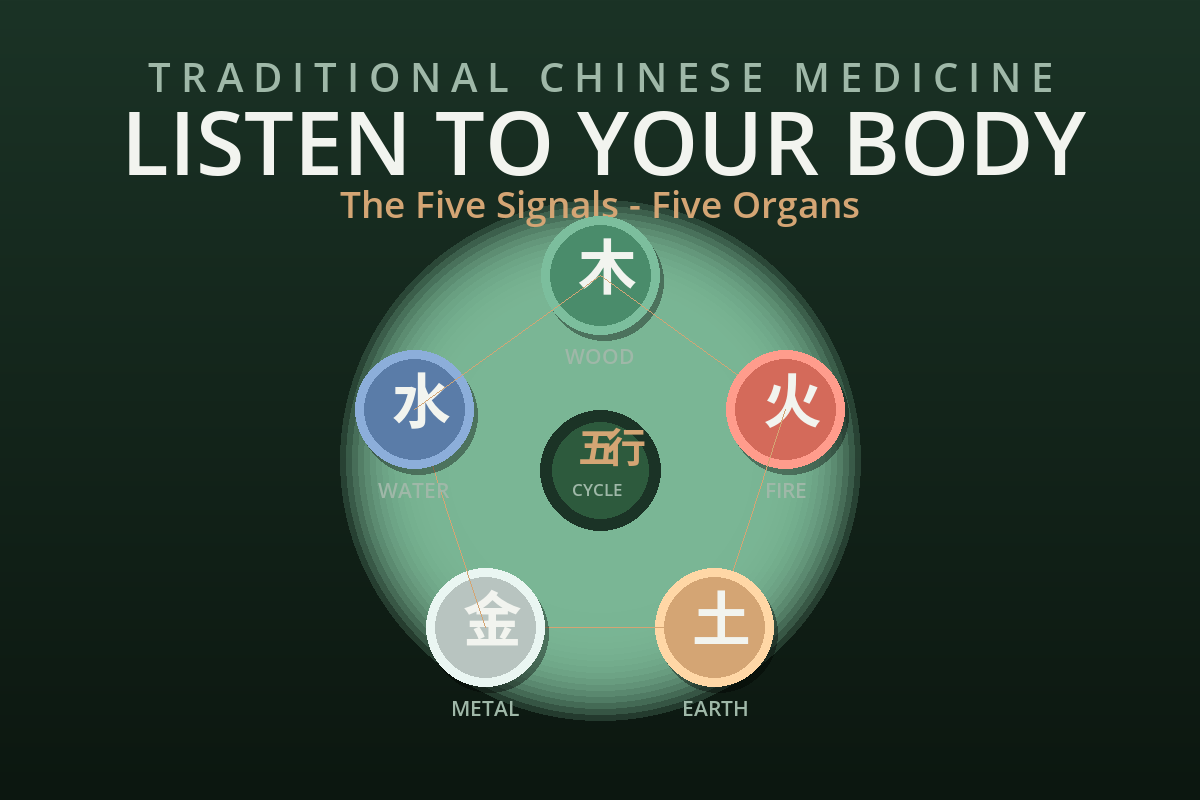
In this article: Your body sends signals long before illness arrives. In Traditional Chinese Medicine, five everyday “too much” signs — gas, sweat, urine, oil, and dreams — each point to a different organ that needs attention.
- The Ancient Saying That Starts It All
- Signal #1: Too Much Gas → Your Liver (肝)
- Signal #2: Too Much Sweating → Your Lungs (肺)
- Signal #3: Too Much Urination → Your Kidneys (肾)
- Signal #4: Too Much Oil → Your Spleen (脾)
- Signal #5: Too Many Dreams → Your Heart (心)
- Your Five-Signal Self-Check
- What to Do Before Reaching for a Formula
- The Takeaway
The Ancient Saying That Starts It All
There’s an old saying in Traditional Chinese Medicine that sounds almost like a riddle:
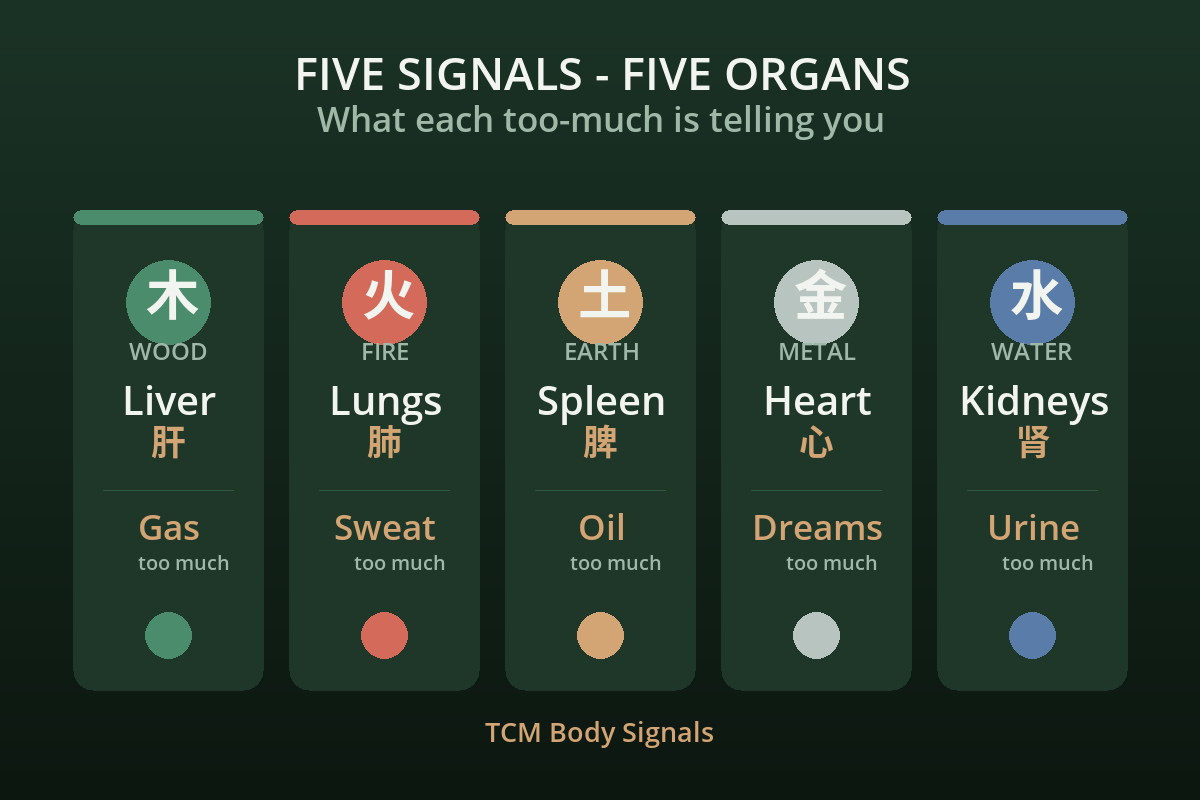
“If your liver is weak, you pass too much gas. If your lungs are weak, you sweat too much. If your kidneys are weak, you urinate too much. If your spleen is weak, your skin gets too oily. If your heart is weak, you dream too much.”
Most people treat these five annoyances as separate, random problems. Gas? Must be something I ate. Sweating? Maybe it’s hot. Night-time urination? Getting older, I guess. Oily skin? Bad genetics. Vivid dreams? Stress.
TCM sees it differently. Each of these signals points to a specific organ system that’s struggling — and understanding the map is the first step to fixing the root cause, not just the symptom.
Signal #1: Too Much Gas → Your Liver (肝)
Here’s the trap: when gas becomes a constant companion, we blame food — too much fiber, carbonated drinks, eating too fast. But if you’re passing gas constantly without obvious dietary causes, TCM asks a different question: how’s your liver?
In TCM, the liver (肝, gān) governs the smooth flow of qi — the vital energy that moves through your whole body. The liver belongs to the Wood element, and the spleen belongs to Earth. Wood naturally “attacks” Earth. So when liver qi gets stuck — the classic pattern of liver qi stagnation (肝气郁结) — it presses down on the spleen’s ability to transform food.
Undigested food doesn’t just sit there. It ferments. It heats up. And it produces the kind of foul, endless gas that escapes in awkward moments — often with a strong odor.
The full pattern looks like this:
- Constant gas, especially after meals
- A tendency to hold in frustration or get irritated easily
- Stuffy, distended feeling on both sides of the ribs
- Dry mouth, bitter taste
- Poor appetite, alternating constipation and loose stools
This is the classic TCM pattern called liver qi stagnation with liver-spleen disharmony. The traditional formula approach? Move the qi and relieve the stagnation — think Mu Xiang Shun Qi Wan (木香顺气丸) or Chai Hu Shu Gan Wan (柴胡疏肝丸), both designed to unclog stuck energy and settle the belly.
Signal #2: Too Much Sweating → Your Lungs (肺)
Some people sweat at the slightest movement — even sitting still, their clothes end up damp. Before blaming “hot blood” or hormones, TCM points upward: to your lungs.
The lungs (肺, fèi) govern the skin and body hair — the “exterior” of the body. The lungs also govern qi, and qi has a holding function: it keeps your pores closed at the right times and controls what leaves the body. When lung qi is deficient, the pores lose their grip. Sweat pours out at the slightest effort — and so does your resistance.
The full pattern looks like this:
- Sweating easily, even when resting
- Waking up with damp pajamas (daytime sweating, not just night sweats)
- Catching colds easily — drafts seem to find you
- Shortness of breath, feeling drained after small efforts
- A soft, pale voice
This is lung qi deficiency with unstable defensive qi (卫气不固). The classic remedy is one of the most famous formulas in TCM: Yu Ping Feng (玉屏风散, “Jade Wind Screen”) — the name means a jade screen that protects you from the wind. Its job is simple: strengthen qi, secure the exterior, stop the leaking.
Signal #3: Too Much Urination → Your Kidneys (肾)
Waking up twice, three times, four times a night. Constant trips to the bathroom during the day. Most people accept this as “normal aging.” TCM disagrees — frequent urination is one of the clearest signals your kidneys are sending.
The kidneys (肾, shèn) partner with the bladder, and kidney yang is the body’s fundamental furnace. Kidney yang has the job of evaporating and transforming fluids — separating the clean, usable water from the waste. When kidney yang weakens, the furnace cools. Water stops being processed and heads straight to the bladder in a constant, diluted stream.
The full pattern looks like this:
- Frequent urination, especially at night
- Feeling cold — hands, feet, lower back
- Aching, weak knees and lower back
- Low energy, foggy mind, occasional dizziness or ringing ears
- Pale, watery urine
This points to kidney yang deficiency (肾阳虚). The classic response: warm the furnace. Jin Gui Shen Qi Wan (金匮肾气丸, from the Golden Cabinet, a formula over 1,800 years old) or Gui Fu Di Huang Wan (桂附地黄丸) — both restore the kidney’s fire so water gets processed instead of dumped.
Signal #4: Too Much Oil → Your Spleen (脾)
Oily hair by noon. A shiny forehead in photos. Pimples that love your T-zone. Skincare companies sell a thousand products for this — but TCM asks what’s happening inside.
The spleen (脾, pí) is the body’s transformation and transportation engine — it turns food into energy and moves fluids where they belong. When the spleen is weak, fluids don’t move properly. They stagnate and turn into dampness (湿气) — a heavy, sticky, turbid substance. And dampness loves to rise: to the head, the face, the scalp, the pores.
The full pattern looks like this:
- Oily scalp, face, and hair that gets greasy fast
- Frequent breakouts and acne
- Heavy, sluggish feeling — like you’re wading through mud
- Bloating after meals
- Loose stools that stick to the toilet bowl
This is spleen deficiency with dampness accumulation (脾虚湿盛). The classic approach: strengthen the spleen and dry the dampness — Shen Ling Bai Zhu San (参苓白术散) or Xiang Sha Liu Jun Wan (香砂六君丸) both help your middle burner process what it’s given, so the oil stops rising.
Signal #5: Too Many Dreams → Your Heart (心)
You fall asleep easily — but spend the night in a film festival. Vivid, exhausting dreams that leave you more tired in the morning than when you went to bed. If this is your life, TCM looks at your heart.
The heart (心, xīn) houses the shen — the spirit-mind that gives you restful sleep and clear thought. The heart needs blood to nourish the shen, the way a lamp needs oil to keep a steady flame. When heart blood runs low, the shen has nothing to anchor it. It wanders — and your nights fill with dreams, while your days fill with forgetfulness.
The full pattern looks like this:
- Falling asleep but dreaming all night, waking exhausted
- Palpitations — heart racing or fluttering, especially at night
- Poor memory, brain fog, losing your train of thought
- Pale complexion, dull lips
This is heart blood deficiency with unsettled shen (心血不足,心神失养). The classic formulas — Gui Pi Wan (归脾丸) or Suan Zao Ren Wan (酸枣仁丸) — nourish the blood and calm the spirit, so the flame settles and the nights grow quiet.
Your Five-Signal Self-Check
| Signal | Organ | TCM Pattern | Classic TCM Formula |
|---|---|---|---|
| Too much gas (foul) | Liver 肝 | Liver qi stagnation | Xiaoyao Wan · Mu Xiang Shun Qi Wan |
| Too much sweating | Lungs 肺 | Lung qi deficiency | Yu Ping Feng (Jade Wind Screen) |
| Too much urination | Kidneys 肾 | Kidney yang deficiency | Jin Gui Shen Qi Wan |
| Too much oil | Spleen 脾 | Spleen dampness | Shen Ling Bai Zhu San |
| Too many dreams | Heart 心 | Heart blood deficiency | Gui Pi Wan · Suan Zao Ren Wan |
What to Do Before Reaching for a Formula
Traditional formulas are powerful tools — but they’re chosen by pattern, not by symptom, and getting the pattern right is a skill. Here’s what you can do safely, starting today:
- Track your signals for two weeks. Note when gas, sweating, urination, oil, or dreams get better or worse. Patterns emerge faster than you’d think.
- Move your body daily. Liver qi stagnation and spleen dampness both melt with regular movement — walking, qigong, tai chi.
- Eat warm, cooked foods. Raw, cold, greasy food loads the spleen and cools the kidney furnace. Warm porridge, soups, and steamed vegetables support all five organs.
- Protect your sleep window. The body repairs organs on its own clock — and the hours before midnight carry special weight in TCM.
- See a qualified practitioner. Herbal formulas work best when prescribed for your pattern. A TCM practitioner (or your doctor) can help you match the signal to the right root cause.
Your body doesn’t speak in symptoms — it speaks in signals. Learn the language, and you can answer before the problem gets loud.
The Takeaway
- Gas that won’t quit often points to the liver’s stuck qi, not just your lunch
- Easy sweating points to lung qi that can’t hold the body’s “exterior”
- Frequent urination points to kidney yang that’s lost its fire
- Oily skin points to spleen dampness rising from within
- Restless dreams point to heart blood too thin to anchor the spirit
None of these signals means panic. They mean attention. Your body has been talking — now you know what it’s saying.