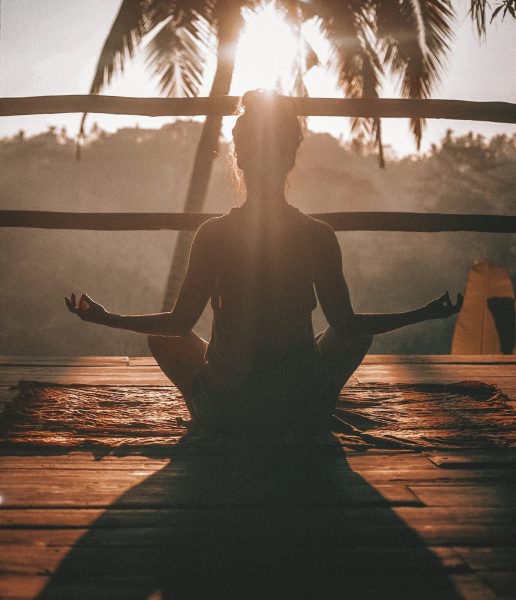
There is a specific kind of heat that settles into your bones during a July afternoon, isn’t there? It’s not just the sweat trickling down your temple; it’s the static feeling in the air, the heavy humidity that makes your chest feel tight, and the irritability that bubbles up when the fan simply moves hot air around the room. In Traditional Chinese Medicine (TCM), we call this “Summer Heat,” a specific pathogen that attacks the body and scatters your Qi (vital energy) like leaves in a storm. While we often look to cooling teas and salads to soothe the body from the inside out, the mind requires a different kind of refreshment. Today, we are going to explore the Waterfall Meditation—a cooling visualization meditation designed not just to help you relax, but to genuinely trick your nervous system into dropping the temperature.
The Science of the “Cool” Mind
Before we close our eyes, let’s look at why visualization works. It sounds a bit like magic, but it is deeply rooted in psychophysiology. When you vividly imagine a sensory experience—like stepping into a freezing cold ocean or standing under a glacial waterfall—your brain doesn’t fully distinguish between the imagined experience and the physical one. The visual cortex lights up, and more importantly, your autonomic nervous system responds.
In TCM, we understand that the Heart is the “Fire Organ” and it houses the Shen (the mind/spirit). When we are overheated, the Shen becomes agitated—think of anxiety, restlessness, and insomnia. A cooling visualization meditation works by soothing the Shen. By introducing the element of Water—the element that controls Fire in the Five Phase cycle—we create a sense of containment and peace.
“In the deep midwinter, one must dig the well; in the high heat of summer, one must still the mind. True coolness comes from within.”
My grandmother used to tell me stories about the monks in the temples near Hangzhou. She said that during the hottest days of the San Fu Tian (the hottest 40 days of the year), they didn’t just sit in the shade. They practiced visualization. They would sit in the sweltering heat and visualize snow falling on their eyelids and icy streams running down their spines. They understood that if the mind is cool, the body follows. If the mind is frantic, the heat becomes unbearable.
Preparing Your Space: Setting the Atmosphere
While the meditation itself is powerful, entering the practice with a few physical adjustments will help you bridge the gap between the physical and the mental. You don’t need a professional yoga studio; you just need a few minutes of intentional setup.
The Temperature Drop: If possible, lower the room temperature by 2 degrees Fahrenheit before you begin, or turn on a fan that oscillates gently to create a breeze. The moving air on your skin will help your visualization feel “real” later on.
Hydration Prep: Do not drink ice water immediately before meditating; it can create “Cold Dampness” in the stomach, which actually hinders digestion and makes you feel sluggish. Instead, brew a cup of Chrysanthemum Tea (Ju Hua) and let it cool to room temperature. Drink it 20 minutes before you sit. This herb is famous in Chinese culture for clearing “liver heat”—the kind of heat that manifests as red eyes and irritability.
- Location: A quiet room, preferably with dim lighting to lower sensory stimulation.
- Clothing: Loose, breathable cotton or linen. No synthetic fabrics.
- Prop: A spray bottle with rosewater and peppermint oil (5 drops of peppermint to 4oz of water). A light mist on the face signals the brain that “cooling” has begun.
- Time: Aim for 15 to 20 minutes. The first 5 minutes are for settling; the deep cooling happens in the middle 10.
The Waterfall Meditation: A Step-by-Step Guide
This is the core of our practice. The goal is to move from a generalized feeling of “wanting to be cool” to a specific, immersive sensory experience. We are going to use the concept of Yi Dao Qi Dao—where the mind goes, the Qi follows. If we put our mind in a waterfall, our Qi will settle into that calm, flowing state.
Step 1: The Root and the Crown (Minutes 1-3)
Sit comfortably in a chair or on a cushion. Place your feet flat on the floor. Imagine roots growing from the soles of your feet, pushing down through the floorboards, through the foundation, and deep into the cool, damp earth. Earth is naturally cool in the summer if you go deep enough. Feel that coolness traveling up through your feet, into your ankles, and settling at your lower abdomen—the Dantian.
Step 2: Constructing the Image (Minutes 4-8)
Close your eyes. Visualize yourself standing at the base of a massive waterfall. It is not a violent, crashing waterfall, but a steady, thick curtain of crystal-clear water falling from a high cliff. The mist is rising around you. Feel the fine spray on your face and arms. Hear the sound—not a roar, but a deep, white-noise hum that vibrates in your chest. The water is coming from a glacier-fed mountain lake, so it is cold. Imagine the color: a brilliant, pale turquoise blue. Make the image as vivid as possible. See the moss on the rocks. Smell the damp stone.
Step 3: The Immersion (Minutes 9-15)
This is where the cooling happens. You are going to walk into the waterfall. As the water hits the crown of your head, visualize it washing away any static, angry, or overheated energy. It flows down your face, your neck, your shoulders. It coats your skin in a layer of pure coolness.
Focus on specific “heat zones”: the chest (Heart Fire), the forehead (anxiety), and the palms (stress). Imagine the water pooling in your palms and then dripping off your fingertips, taking the heat with it. As the water flows down your spine, imagine it lighting up your central nervous system with a cool blue light.
Step 4: The Pool of Stillness (Minutes 16-20)
The water collects at your feet, forming a still, deep pool. You are standing in this pool, waist-deep. The water is perfectly still now. There is no movement, only profound coolness. Rest here. Breathe in coolness; breathe out heat. When you are ready, slowly bring your awareness back to the room, keeping that internal temperature low.

Why Water? Understanding the TCM Connection
In the West, we often think of water simply as H2O—something we drink. In TCM, Water is a profound philosophical and physiological force. It is one of the Five Elements (Wood, Fire, Earth, Metal, Water), and it corresponds to the Kidneys.
The Kidneys are considered the “Root of Life.” They store our Jing (essence)—our deepest reserves of energy, like a savings account. Summer is a time of expansion and expenditure; we stay out late, we play hard, and we sweat. This uses up our Qi. The Kidney system (Water) is the only thing that can keep the Heart system (Fire) in check.
If you have ever felt “tired but wired” during a heatwave—where your body is exhausted but your mind won’t stop racing—it is because your Water element is depleted and cannot control the Fire. The Waterfall Meditation is not just a stress relief tool; it is a way to “water the Kidneys.” By visualizing water, we nourish the actual organ system. We signal to the body that we are in a safe, fluid environment, allowing the Kidneys to relax and replenish their reserves.
Enhancing the Practice: The “Cooling Kit”
To make this meditation even more effective, especially on days when the heat feels suffocating, you can combine the visualization with physical cooling agents. Here is a breakdown of tools you can use alongside your practice to deepen the effect.
| Tool | How to Use It | TCM Benefit |
|---|---|---|
| Mung Bean Tea (Lu Dou) | Drink 8oz, room temperature, 30 mins before practice. | Clears heat and relieves thirst; detoxifies. |
| Peppermint Oil | Dilute to 2% and apply to temples and wrists. | Opens pores to release trapped heat (releases the exterior). |
| Cool Jade Stone | Hold in your left hand (Heart side) during meditation. | Jade is yin; it draws heat out of the Pericardium meridian. |
| Water Sounds | Play recordings of rain or flowing streams. | Auditory cues help anchor the mind in the Water element. |
A note on Ice: Please avoid using actual ice packs or drinking ice water during the meditation. In TCM, extreme cold can constrict the meridians and trap heat inside the body (like putting a lid on a boiling pot). We want “cooling,” not “freezing.” We want to gently disperse the heat, not shock the system.
Breathing the Cool: The “Ha” Breath
Breathing is the engine of meditation. For this specific cooling practice, standard deep breathing is good, but the “Ha” Breath is better. This is a technique adapted from Qigong (specifically the practice of “Six Healing Sounds”).
The “Ha” sound is associated with the Heart and the Fire element. By making this sound on the exhale, you physically vibrate the heart center and expel stale Qi.
How to do it:
- Inhale deeply through your nose, imagining you are sucking in cool blue light into your heart center. Fill the chest completely.
- Pause for one second at the top of the breath.
- Exhale slowly through your mouth, making a gentle “Haaaaa” sound (like the sound you make when you breathe on a pair of glasses to clean them, but louder and from the belly).
- Visualize the breath leaving your mouth as red or orange smoke—the heat leaving your body—while the blue light remains inside.
Do this for 9 to 18 cycles (multiples of 3 are significant in Chinese numerology for health). You should feel a distinct drop in your internal temperature and a slowing of your heart rate.
Integrating the Chill: Post-Meditation Care
The biggest mistake people make after a cooling meditation is jumping right back into the heat—both physically and emotionally. If you finish the Waterfall Meditation and immediately check your stressful email or step out into the 3pm sun, you will lose the benefit instantly.
Think of your body like a computer that has just been rebooted. You need a “cool down” period.
- The 5-Minute Rule: Stay seated with your eyes closed for at least 5 minutes after the meditation ends. Gently wiggle your fingers and toes before moving your larger joints.
- Hydrate Smart: Now is the time for water. But make it “cooling water.” Add a slice of cucumber, a sprig of mint, or a few goji berries to your glass. Cucumber is incredibly cooling to the stomach.
- Eat a Cooling Snack: If you are hungry, eat a piece of watermelon (Xi Gua). In TCM, watermelon is called “White Tiger Decoction” because it is so powerful at clearing summer heat. It is essentially a medicinal fruit.
- Avoid Spicy Food: For the next 4 hours, try to avoid chili peppers, ginger, or garlic. These generate heat and will undo your hard work. Stick to bitter greens like dandelion greens or bok choy.
My mother used to make a dessert soup called Lily Bulb and Snow Pear Soup for hot summer nights. It’s simple: boil one snow pear (cut into cubes) with 10 grams of dried lily bulbs (Bai He) and a few rock sugar crystals. The pear moistens the lungs, and the lily bulb calms the spirit. Eating this after an evening meditation is a perfect way to seal in the coolness before sleep.
Common Questions
Can I do this meditation outside in the shade?
You can, but it requires more discipline. The wind, the buzzing of insects, and the fluctuating temperature can make it harder to focus. I recommend practicing indoors in a controlled environment for the first two weeks. Once you are comfortable with the visualization, you can try it outside. Sitting on a rock or the earth is best, as the ground has a natural cooling quality. Just ensure you are protected from direct sunlight, which scatters the Shen.
What if I can’t visualize clearly? I just see black.
That is very common and nothing to worry about. “Visualization” doesn’t always mean seeing a high-definition movie in your head. It can be a “felt sense.” Focus on the sensation of water rather than the image. Feel the wetness on your skin, the coolness in your lungs, the sound of the splash. If you focus on the physical sensation, the image often follows. If it doesn’t, the sensation is enough to trigger the cooling response in your nervous system.
I feel dizzy or cold after meditating. Is that normal?
If you feel dizzy, you might be hyperventilating or dropping your blood pressure too quickly. Ensure your “Ha” breath is not too forceful. If you feel genuinely cold (shivering), you may have overdone the visualization or you have a “Cold” constitution to begin with. In TCM, some people are already too “Yin” (cold). If this is you, focus less on “ice” or “glaciers” in your visualization and more on a “cool, gentle spring rain” or “lukewarm stream.” The goal is to restore balance, not to freeze yourself.
The bottom line: The Waterfall Meditation is a powerful, accessible tool to reclaim your inner equilibrium during the hottest days of the year. By combining specific breathing techniques (The Ha Breath), sensory immersion, and TCM principles of the Water element, you can lower your cortisol levels, soothe your Heart Fire, and find a pocket of glacial stillness within a chaotic summer day. You don’t need air conditioning to find peace; you just need to let the water flow.
This article is for educational purposes and reflects traditional wellness perspectives. It is not a substitute for professional medical advice, diagnosis, or treatment.