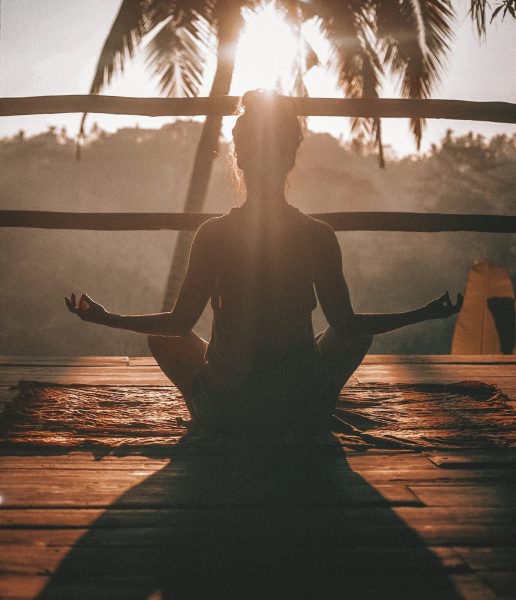
Have you ever noticed how your thoughts behave on a sweltering summer day? They don’t flow; they stick. They buzz around your head like sticky flies, refusing to settle. In Traditional Chinese Medicine (TCM), this isn’t just a mood—it’s a physiological state. When the body gets hot, the Shen (your spirit or mind) gets agitated. It becomes restless, scattered, and anxious. We often try to cool down by turning up the AC, but that only cools the skin. It doesn’t touch the heat that is radiating from your chest or the back of your eyes.
I remember growing up, my Nai Nai (grandmother) would never let us drink ice water when we were angry or overheated from the summer sun. She said it would “shock the stomach.” Instead, she would make us sit in the shade of the persimmon tree and close our eyes. “Imagine a cool mountain spring,” she’d say, tapping her forehead gently. “Let it wash the dust away.” I thought it was just a game to make us stop complaining about the heat, but decades later, I realize she was teaching me a profound form of cooling meditation visualization. It is a way to lower your internal temperature without changing the thermostat. Today, I want to share a variation of her wisdom with you—a practice I call the “Waterfall Meditation.” It takes less than three minutes, requires no special equipment, and can instantly clear the fog of frustration.
- Why Your Brain Needs a "Cool Down" Button
- The Science of the Stream: Understanding the Visualization
- The 3-Minute "Waterfall" Protocol
- TCM Insights: The Cooling Points
- When to Use the Waterfall: A Practical Guide
- The Cultural Context: Why Water is the Ultimate Healer
- Enhancing the Practice: Environment and Aids
Why Your Brain Needs a “Cool Down” Button
In Western psychology, we talk about “hot cognitions”—decisions made in the heat of the moment that we later regret. In Eastern wellness, we look at this through the lens of temperature and energy. According to TCM, the Heart is considered the “Emperor” of the body, and it houses the Shen. The Heart is a Fire element organ. It needs a bit of Fire to function—warmth, joy, connection. But when the Fire blazes out of control due to stress, weather, or spicy food, the Emperor panics. The mind races. Sleep becomes impossible. You feel a sense of urgency for no reason.
Cooling meditation isn’t about “turning off” your brain. It is about introducing the Water element to balance the Fire. Think of your mind like a computer processor. If the fan breaks and the processor overheats, the system glitches or shuts down to protect itself. A cooling visualization acts as that fan. It creates a thermal shift in your perception, signaling the parasympathetic nervous system to stand down. When you visualize cold water, your body often responds physically—you might notice your shoulders drop, your jaw unclench, and your breathing deepen. This is the physiological reality of imagination impacting the body.
“If you want to find the secrets of the universe, think in terms of energy, frequency, and vibration.”
— Nikola Tesla (and a concept deeply embedded in Chinese medicine)
The Science of the Stream: Understanding the Visualization
Why a waterfall? Why not just thinking about an ice cube? The efficacy of this practice lies in the movement of the water. Stagnant water—even if it is cold—eventually becomes swampy. We want moving water because moving water represents Qi (life energy) in motion. When you visualize a waterfall, you are combining the cooling properties of water with the cleansing properties of flow.
In my practice, I often explain Yin and Yang to my students not as mystical opposites, but as functional states. Yang is the fire, the activity, the “doing”—it expands outward. Yin is the water, the rest, the “being”—it gathers and cools inward. Most of us living in modern cities are chronically Yang-dominant. We are always on, always producing heat. This meditation is a deliberate dose of Yin. By imagining a cascade of crystal-clear mountain water flowing over you, you are bathing your nervous system in Yin energy.
The goal is to engage all your senses within the imagination. You want to “feel” the mist on your arms, “hear” the roar of the crash, and “see” the blue tint of the water. The more specific the sensory input in your mind, the more your body believes it is happening, and the deeper the relaxation response.

The 3-Minute “Waterfall” Protocol
This practice is designed to be done anywhere—at your desk, on a crowded train, or in bed before sleep. It is broken down into three distinct phases: The Call, The Cascade, and The Pool. Ideally, set a timer for 3 minutes so you don’t have to watch the clock, allowing you to fully surrender to the imagery.
Phase 1: The Call (Seconds 0–45)
Close your eyes. Take a deep breath in through your nose for a count of four, and exhale through your mouth for a count of six. Do this three times. Now, shift your attention to the top of your head—your Crown Chakra, or in TCM, the Baihui point. Imagine that you are standing in a dense, humid jungle. It is sticky. You are tired. Then, you hear it in the distance: the sound of rushing water. It pulls you forward.
Phase 2: The Cascade (Seconds 45–120)
You step out of the jungle into a clearing. There is a magnificent waterfall in front of you. It isn’t violent; it is powerful but benevolent. You step under it. Visualize the water hitting the crown of your head. It is cool—not freezing, but refreshing, like spring snowmelt.
As the water hits your head, visualize it washing away a gray “dust” that represents your stress. Watch the water flow down over your face, soothing your eyes (which hold the heat of frustration). Watch it flow down your neck and shoulders, melting the tension knots like wax. Finally, watch it cascade down your torso and legs, washing away the gray dust until it swirls down into the ground, dark and dirty, leaving you clean.
Phase 3: The Pool (Seconds 120–180)
The waterfall has stopped, but you are standing in a pool of cool, still water up to your ankles. The sun is warm on your shoulders, but your body is cool. Take a moment to feel the lightness. You are no longer sticky. You are no longer hot. Your mind is no longer buzzing. You are just… still. Open your eyes slowly.
TCM Insights: The Cooling Points
To make this visualization even more effective, you can incorporate a light physical touch on specific acupressure points that are known to clear heat from the head. When I do this with my students, I have them place their thumbs gently on two specific spots while they imagine the waterfall.
- Yintang (The Third Eye): Located directly between your eyebrows. In TCM, this is the “Hall of Impression.” It calms the Shen (spirit). When you press here gently while visualizing cool water, it acts like a direct plug into the nervous system, instantly signaling “safety.”
- Feng Chi (Wind Pool): These points are located at the base of the skull, in the hollows on either side of the neck, about two inches apart. These are the gates where “Wind” (pathogens and tension) enters the body. Pressing here helps release the heat trapped in the head and neck, often causing immediate relief from headaches or eye strain.
Combining the mental image of the waterfall with the physical pressure on these points creates a double-layered approach to cooling. You are engaging the mind-body connection on two fronts: the cognitive (imagination) and the somatic (touch).
When to Use the Waterfall: A Practical Guide
While you can technically do this any time, there are specific “heat scenarios” where this meditation acts as a medicinal intervention rather than just a relaxation exercise. I have compiled a table of common “hot” situations and how to adapt the waterfall practice for maximum effect.
| Scenario | Symptom | Waterfall Adaptation |
|---|---|---|
| The “Angry Heat” | Red face, shouting, rapid pulse, feeling of pressure in the chest. | Focus the visualization on the Chest and Face. Imagine the water is icy blue. Breathe out the color red (anger) with every exhale. |
| The “Overheated” Brain | Brain fog, inability to focus, feeling like your head is in a vice. | Focus on the Crown and Temples. Imagine the water pouring directly into the center of the brain, filling it up and cooling the “processor.” |
| The “Summer Sluggishness” | Humidity fatigue, heavy limbs, lack of motivation. | Focus on the Lower Legs. Imagine cool water rushing over your shins and ankles. This “grounds” the heat and wakes up the circulation. |
| The “Night Heat” | Insomnia, night sweats, restless legs, racing thoughts at 2 AM. | Focus on the Palms of Hands and Soles of Feet. In TCM, these are the “bubbling wells” (Yongquan and Laogong). Imagine the cool water draining out of these four holes, pulling the heat out of the body and into the earth. |
The Cultural Context: Why Water is the Ultimate Healer
In Chinese philosophy, water is revered not just for its cooling properties, but for its character. Lao Tzu famously wrote that “Nothing is softer or more flexible than water, yet nothing can resist it.” When we visualize a waterfall, we aren’t just trying to lower our body temperature; we are trying to embody the nature of water.
When you are angry or stressed, you become like rock—rigid, unmoving, heavy. Water flows around the rock. It does not fight the rock; it simply erodes it over time or slips past it effortlessly. By meditating on water, you invite that fluidity back into your life. You are reminding yourself that you don’t have to “push through” the stress. You can flow around it.
I recall a specific summer in Guangzhou when the humidity was so high you could practically swim through the air. I was working a corporate job, sweating through my shirt before 9 AM, and snapping at my colleagues. My father saw me struggling. He didn’t offer tea (which is the usual remedy). Instead, he took me to a Koi pond in a local park. We sat there for ten minutes watching the fish. “Look at the water,” he said. “Does it try to cool down? No. It just is cool. Be the water, not the rock.” It sounds poetic, but physiologically, shifting my focus from my internal heat (the rock) to the external coolness (the water) dropped my heart rate and cleared my head in minutes. This meditation is the distilled version of that lesson.
Enhancing the Practice: Environment and Aids
While the mind is the primary tool here, our external environment supports our internal state. If you want to deepen the effect of the Waterfall Meditation, you can curate your physical environment to match the visualization. This is especially helpful if you are a beginner or if you are feeling particularly “fired up” and need a strong anchor.
Here are three concrete ways to amplify the cooling effect:
- Peppermint Oil: Peppermint is considered cooling in both Western aromatherapy and TCM. Place one drop of peppermint essential oil on a tissue and hold it near your nose, or dilute it and dab a tiny amount on your temples before you begin the visualization. The physical sensation of cold on the skin pairs perfectly with the mental image of water.
- Chrysanthemum Tea (Ju Hua Cha): My grandmother’s favorite. Brew a handful of dried yellow chrysanthemum flowers in hot water, let it cool to room temperature, and sip it slowly before or after the meditation. It clears heat from the liver and brightens the eyes. It is the liquid equivalent of this practice.
- Soundscapes: If silence is too loud for you, play a recording of rain or a stream. Auditory stimulation can significantly lower the barrier to entering a meditative state. The brain easily entrains to the rhythm of natural water sounds.
Common Questions
I can’t visualize clearly—does it still work?
Absolutely. You do not need to have “movie-quality” visuals in your mind’s eye. In fact, many people are more kinesthetic (feeling-based) or auditory (sound-based) than visual. If you can’t “see” the water, focus on the feeling of cool droplets hitting your skin, or the sound of the roar. Your brain responds to the intent and the sensory focus, not just the visual clarity. If all else fails, simply repeat the phrase “cool, flowing, clear” to yourself as a mantra.
How is this different from just “cooling down” with air conditioning?
Air conditioning lowers the ambient temperature of the room, which cools your skin and body. However, it does nothing for “emotional heat” or the Yang excess in your mind. In fact, staying in dry AC air too long can lead to dry skin and a dry throat, which are signs of Yin deficiency. The Waterfall Meditation cools you from the inside out. It regulates the nervous system’s response to stress. You can do this meditation in a hot room and still feel a psychological sense of relief, even if you are still sweating physically.
Can I do this meditation for my child?
Yes, and it is highly effective for children, especially those prone to tantrums or night terrors. Children have vivid imaginations and often respond faster than adults. You can guide them through it by telling a story: “Let’s pretend we are explorers in a hot jungle, and we found a secret magic waterfall…” You can even spray a little cool mist from a spray bottle on their face and arms to provide a tactile anchor for the visualization. It turns a stressful moment into a game.
The bottom line: The 3-Minute Waterfall Meditation is more than just a relaxation trick; it is a vital tool for regulating your internal climate. By harnessing the power of cooling meditation visualization, you tap into the Water element to balance the Fire of modern life. Whether you are dealing with summer heat, anger, anxiety, or insomnia, taking three minutes to wash your mind with a mountain stream can restore clarity, calm, and resilience. Close your eyes, hear the roar, and let the water flow.
This article is for educational purposes and reflects traditional wellness perspectives. It is not a substitute for professional medical advice, diagnosis, or treatment.