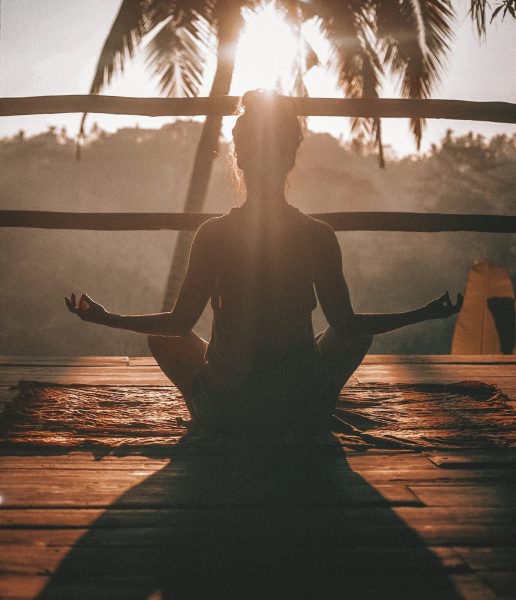
There is a specific kind of heat that settles into the city around mid-July. It’s not the bright, sharp heat of June, but a heavy, damp blanket that seems to rise from the pavement and cling to your skin. My grandmother used to call this shu shi—summer dampness. While modern wellness culture tells us to combat this with iced lattes and blasting air conditioning, traditional Chinese wisdom suggests a different approach: counteracting heat with cool stillness, not just cold objects. As the earth heats up, we are encouraged to look upward. There is a vast, cooling reservoir available to us every single night, free of charge and older than time itself: the night sky. Tonight, we are going to explore a practice I call the “Jade Canopy” meditation, a technique designed to pull the rising heat out of your mind and anchor you in the expansive coolness of the cosmos.
The Science of “Cosmic Bathing”
In Western astronomy, we look up to measure distances and study physics. In Eastern philosophy, we look up to borrow energy. When we spend all day under artificial lights, staring at screens two feet from our faces, and focusing on the small anxieties of the human world, our qi (vital energy) becomes stagnant and hot. It rises to the head, leading to what we call “monkey mind”—that frantic, looping thought pattern that keeps you awake at 2:00 AM.
The night sky offers an immediate antidote to this contraction. It represents the ultimate Yin state. Yin is not just “darkness”; it is the principle of coolness, depth, rest, and nourishment. When you gaze into the void of space, you are engaging in a practice known in some Daoist lineages as “Cosmic Bathing” (Mu Yu Xing Chen). You aren’t just looking at the stars; you are allowing the vast, cooling frequency of the universe to wash over your turbulent, heated human energy. Think of it like this: if your mind is a boiling pot of water, the night sky is the infinite cool breeze that slowly lowers the temperature until the water is still.
“The quieter you become, the more you can hear. The darker the night, the brighter the stars shine. We do not force the mind to stop; we simply offer it a space larger than its worries.”
Preparing Your “Star-Gazing Nest”
You cannot practice deep meditation while shivering or swatting mosquitoes. The physical setup is crucial because the body must be comfortable enough to forget it exists. We are aiming for a state of “effortless ease.” Do not underestimate the power of preparation; in my family, the preparation for evening meditation was as sacred as the practice itself.
First, location matters. Ideally, find a spot away from streetlights—a backyard, a balcony with privacy screens, or a local park that allows evening access. If you live in a city with heavy light pollution, don’t worry. Even the urban sky holds the vastness of space; you might just see fewer stars, but the darkness above the haze is still there.
Second, you must protect your surface energy. In Traditional Chinese Medicine (TCM), the back of the body is considered the “Yang” side, housing the Du Mai (Governing Vessel), which regulates our defense energy. Lying directly on cold concrete or damp grass can shock the system. My grandmother would have scolded me for even thinking about it.
- The Base Layer: Use a thick yoga mat, a folded quilt, or a camping pad. You need at least 2 inches of insulation between you and the ground.
- The Cover: Have a light, breathable blanket (cotton or bamboo fabric is best) to cover your legs and abdomen. The abdomen houses the Dan Tian (energy center) and must remain warm to feel safe.
- The Neck Support: Use a small pillow or a folded towel. If your neck is strained, your mind will not quiet down.
- Optional: A small spray bottle with peppermint water to mist your face, adding a sensory layer of “coolness.”
The “Jade Canopy” Meditation Technique
This is a specific visualization practice. We aren’t just “zoning out”; we are actively guiding the mind to create a physiological shift in our nervous system. The goal is to move from Sympathetic dominance (fight or flight) to Parasympathetic dominance (rest and digest) by utilizing the visual metaphor of the sky.
Step 1: The Root and the Roof
Lie on your back, arms resting comfortably by your sides, palms facing up. This open-palm posture symbolizes receptivity—you are open to receiving the cool energy of the night. Close your eyes for the first three minutes. Visualize roots growing from your lower back and glutes deep into the earth. This grounds your energy so you don’t feel “floaty” or anxious. Then, slowly open your eyes. Let your gaze soften. You are not focusing on the stars; you are looking through them into the black velvet behind them.
Step 2: Inhaling the Silver Light
Now, we use the breath to bridge the gap between earth and sky. In Chinese medicine, the lungs are associated with the Metal element and the emotion of grief or letting go. We will use the breath to let go of heat.
Inhale deeply through your nose for a count of 4. As you inhale, visualize a stream of cool, silver-blue light pouring down from the furthest star you can see, entering through the crown of your head. Exhale through your mouth for a count of 6. As you exhale, visualize grey, heavy smoke (the heat of the day) leaving the soles of your feet and sinking into the ground. Do this for 10 cycles. The exhale must be longer than the inhale to trigger the vagus nerve.
Step 3: The Expanding Sphere
This is where the magic happens. Imagine a small sphere of blue light in the center of your chest, right over your sternum. With every breath, allow this sphere to expand slightly. Imagine it growing until it encompasses your body, then your yard, then your neighborhood, then your city, and finally, it merges completely with the infinite dark space above you. You are no longer a small person looking up; you are the vast space looking down at a small, resting human. This shift in perspective is profound. It dissolves the ego’s grip on your problems.
Aligning with the Lunar Rhythms
In Chinese agriculture and medicine, the moon is not just a celestial body; it is a regulator of fluids. Just as the moon controls the tides of the ocean, it is believed to influence the tides of our blood and fluids (Xue and Jin Ye). Practicing night sky meditation is most potent when you align it with the moon’s cycle. Here is how you can tailor your practice based on the lunar phase to address specific wellness goals.
| Lunar Phase | Energy Quality | Focus of Meditation | Recommended Tea |
|---|---|---|---|
| New Moon | Deep Yin / Rest | Focus on setting intentions. The sky is darkest, offering maximum stillness. Visualize planting seeds in the dark earth. | Chrysanthemum & Goji Berry Tea (cooling/liver support) |
| Waxing Moon | Growth / Building | Focus on gathering energy. Visualize drawing starlight into your bones to build strength. | Warm Water with Lemon and Honey (nourishing fluids) |
| Full Moon | Yang / Expansion | Focus on gratitude and release. Emotions may run high. Use the “Expanding Sphere” technique to release tension. | Peppermint Tea (disperses heat/anger) |
| Waning Moon | Release / Shedding | Focus on letting go. Visualize the silver light washing away physical toxins and emotional baggage. | Jujube (Red Date) Tea (calms the spirit) |
A personal tip: I find the three days leading up to the Full Moon to be the most restless for sleep. If you struggle with insomnia during this time, do not fight it. Get up, go outside, and do this meditation for 20 minutes. The moonlight acts as a natural sedative for the Shen (spirit) when viewed with soft eyes.
The “Jade Pillow” Herbal Compress
To deepen the cooling effect of your night sky meditation, we can incorporate a topical remedy from the herbal medicine cabinet. In TCM, we often treat “heat rising to the head” with aromatics that guide the energy downward. After your meditation, or even while you are lying on your mat, you can use a simple herbal compress on your forehead or the crown of your head.
Create a “Jade Pillow” infusion. You will need:
- 1 tablespoon of dried Peppermint leaves (Bo He)
- 1 tablespoon of dried Chrysanthemum flowers (Ju Hua)
- 2 cups of boiling water
Steep the herbs in the boiling water for 15 minutes. Strain the liquid and let it cool until it is lukewarm. Soak a soft washcloth (preferably cotton) in the infusion, wring it out slightly so it doesn’t drip, and place it over your forehead and temples while you gaze at the sky. The volatile oils from the peppermint create a sensation of coolness that penetrates the skin, while the chrysanthemum clears heat from the liver channel, which often manifests as red eyes or a headache after a long day in the sun.
Overcoming the Fear of the Dark
Let’s be honest: for many of us, sitting alone in the dark can be unsettling. Modern humans are conditioned to fear the night. We flood our spaces with LED lights the moment the sun dips below the horizon. But in the Daoist tradition, the night is the womb of creation. It is the source of all potential. If you feel anxiety creeping in during your practice, do not push it away. Acknowledge it.
I remember as a child being terrified of the shadows in my room. My mother didn’t tell me “there’s nothing there.” Instead, she told me to breathe with the shadow. “The shadow is just the place where the light hasn’t touched yet,” she said. “It needs your breath to feel welcome.” This reframe changed my relationship with darkness forever. When you meditate under the stars, you are practicing befriending the unknown. You are teaching your nervous system that darkness is not danger; it is rest.
If you are practicing in a city, the ambient noise can be a barrier. I recommend using noise-canceling headphones, not with music, but with a recording of “brown noise” or wind sounds. This helps isolate the visual experience of the stars from the auditory chaos of the urban environment, allowing you to drop into that deep, still space more quickly.
Integrating the Stillness: The Morning After
The benefits of night sky meditation aren’t limited to the night itself; they profoundly impact the following day. When you fill your reservoir with Yin coolness at night, you have more balanced Yang energy to use during the day. You will likely notice that you are less reactive to heat, less irritable with coworkers, and more focused in your tasks.
To seal in the practice, I suggest a simple morning ritual. Upon waking, before you check your phone or turn on the lights, drink a glass of room temperature water with a slice of cucumber. This continues the “cooling” theme and hydrates the body gently. Then, take 30 seconds to recall the vastness you felt the night before. Remember the feeling of being a tiny speck in a beautiful, infinite universe. This perspective keeps the “small stuff” in its place. It is a powerful antidote to the frantic pace of modern life.
Remember, this practice is about consistency, not duration. Five minutes of genuine connection with the night sky is better than an hour of distracted sitting. Make it a habit, even if just once a week. Let the cosmos be your weekly reset button.
Common Questions
Can I do this meditation if it’s cloudy or raining?
Absolutely. In fact, rainy nights offer a unique variation of this practice. The clouds act as a softener, diffusing the light and creating a gray, velvet canopy that feels incredibly nurturing. The sound of rain is naturally grounding. If it is raining, sit under a covered porch or awning so you remain dry. Focus on the sound of the rain hitting the roof or the ground—it is the earth’s own cooling music. Visualize the rain washing the heat out of the atmosphere and out of your body.
Is it safe to look at the stars for a long time? Will it strain my eyes?
When we talk about “stargazing” in this context, we are using “soft eyes.” You are not squinting or focusing intensely on a single point. You are letting your gaze relax, similar to looking at a Magic Eye poster but without the effort. This actually rests the ciliary muscles of the eyes, which are strained from close-up screen work. However, if you feel any tension in your forehead or eyes, simply close them and visualize the starfield in your mind’s eye—you will get 90% of the benefit with zero strain.
What if I live in a place with heavy light pollution and can’t see any stars?
Light pollution is a modern challenge, but it doesn’t defeat the practice. The goal is connecting with the “vastness” above, not necessarily counting specific constellations. Even in a bright city, the sky above the glow is still infinite space. If you truly cannot see the sky, you can replicate this experience indoors. Lie on the floor and project a simple star map on your ceiling (many apps offer this). Dim all other lights. The brain responds similarly to projected starlight as it does to real starlight regarding the release of melatonin and the calming of the nervous system. It is the intent and the perspective that matters most.
The bottom line: The night sky is the ultimate cooling tonic for the modern, overheated mind. By lying down, breathing in silver light, and expanding our perspective beyond our earthly worries, we tap into a deep well of Yin energy that restores balance, improves sleep, and brings a sense of profound peace. Make a date with the stars this week; your nervous system will thank you.
This article is for educational purposes and reflects traditional wellness perspectives. It is not a substitute for professional medical advice, diagnosis, or treatment.