There is a specific, heavy energy that settles over a city in July around 6:00 PM. The sun is still high, the asphalt has been baking all day, and stepping outside feels less like walking and more like wading through warm soup. In Traditional Chinese Medicine (TCM), we call this the peak of Yang energy—active, hot, and rising. While this is natural to the season, our modern lives don’t always allow us to follow nature’s rhythm. We blast air conditioning, drink iced coffee until sunset, and scroll through blue-light screens while our bodies are screaming for a way to discharge the heat. The result? You lie in bed at 11:00 PM feeling wired but tired, your mind racing while your body feels heavy. If you want to reclaim your nights and sleep like you did when you were a child, you need a Summer Evening Reset. It isn’t about a complex hour-long ritual; it’s about five small, specific habits to tell your nervous system that the sun has gone down, even if the thermostat says otherwise. Here is how to cool your day, literally and figuratively.
1. The “Internal Air Conditioner” Tea (6:00 PM – 7:00 PM)
My grandmother used to say that you can’t fight fire with fire, but you also can’t fight it with ice. This is a common mistake in the West: trying to cool down by drinking freezing smoothies or iced beer. In TCM, extreme cold shocks the Spleen and Stomach (your digestive system), causing it to contract. This actually traps heat inside your body, leading to bloating and sluggish digestion, which generates more internal heat later on. It’s a vicious cycle.
Instead, we want to use herbs that clear “Summer Heat” (a specific TCM pathogen) and promote urination to flush out toxins. We want to drink this tea at room temperature or slightly warm to induce a gentle sweat. Sweating is the body’s natural AC unit; it releases heat from the pores.
Here is a blend I drink three times a week during the hottest months. It tastes like a mild, earthy green tea with a hint of sweetness.
“The goal of summer hydration isn’t just to quench thirst, but to transform dampness and guide heat downward and out.”
The Recipe: Mung Bean & Job’s Tears (Coix Seed) Water
Ingredients:
- 1/4 cup dried Mung Beans (green skin on)
- 1/4 cup Job’s Tears (Yi Yi Ren) – available at Asian grocery stores or health food stores
- 2 slices of fresh Ginger (to protect the stomach)
- 6 cups of Water
- Rock sugar or Honey to taste (optional)
Instructions: Rinse the beans and grains. Place them in a pot with water and ginger. Bring to a boil, then simmer on low for 45 minutes until the beans crack open. Strain and drink the liquid (you can eat the soft beans if you want extra fiber). This combination is renowned in Chinese medicine for “draining dampness.” Mung beans are specifically indicated for summer heat toxicity, while Job’s Tears act as a gentle diuretic. Drinking a cup of this around 6:00 PM starts the cooling process before bed.
2. The “Fire-Water” Foot Soak (8:00 PM)
This sounds counterintuitive, I know. Why would you soak your feet in warm water when it’s already 90°F outside? Because in the summer, all your energy and blood rise to the surface of your skin to dissipate heat. Your head gets hot, but your feet—the roots of your body—often get neglected. This leaves you with a “top-heavy” feeling: a headache, a flushed face, and a restless mind, but cold feet.
A foot soak draws that chaotic Yang energy back down to the ground. It grounds you. However, the temperature is critical here. In winter, we soak hot. In summer, we soak warm. Too hot will make you feel dizzy.
The Protocol
Use a bucket or basin that allows water to cover your ankles and reach the Spleen 6 (San Yin Jiao) acupuncture point, which is located about four finger-widths above the ankle bone on the inner leg. This point regulates the three yin meridians of the foot and is a powerhouse for calming the mind.
Temperature: 100°F to 104°F (38°C to 40°C). Test it with your elbow; it should feel comfortable, not scalding.
Duration: 15 to 20 minutes.
The Secret Ingredient: Add a handful of Dried Mugwort (Ai Ye) or a cup of Epsom salts. Mugwort is warming but moves stagnant blood and calms the spirit (Shen). As you soak, the heat dilates the blood vessels in your feet. As you get out and dry off, the evaporation causes rapid cooling, which signals your body that it’s time for sleep.
3. The Cooling Kitchen Remedies (Dinner Strategy)
When the weather is hot, your digestion naturally weakens. We call this “Spleen Qi Deficiency.” You might notice that in winter you crave heavy stews, but in summer, the thought of a heavy steak makes you feel sluggish. That is your body telling you to eat lighter.
For your summer evening reset, we are going to construct a “Cold Salad” in the TCM sense. This means food that is energetically cooling, not necessarily physically cold. (Again, avoid ice-cold meals if you can, as they slow digestion). Here are specific ingredients you should incorporate into your dinner rotation to vent heat and calm inflammation.
| Food/Herb | TCM Property | Modern Benefit | How to Use Tonight |
|---|---|---|---|
| Bitter Melon (Ku Gua) | Cold nature; clears heat | Lowers blood sugar; aids digestion | Slice thin, blanch for 2 mins, toss with sesame oil and soy sauce. |
| Mung Bean Sprouts | Cool nature; relieves thirst | High in Vitamin C | Sauté quickly with garlic (1 min) for a crunchy side. |
| Loofah Gourd (Si Gua) | Cool nature; clears summer heat | Hydrating; high fiber | Simmer in a light broth with shrimp for 10 mins. |
| Chrysanthemum (Ju Hua) | Cold nature; clears the head | Relieves headaches/eye strain | Steep 5-8 flowers in hot water for 5 mins as an after-dinner tea. |
| Watermelon (Xi Gua) | Cold nature; diuretic | Hydration; lycopene | Eat the white rind (Pi) pickled or juiced—this is actually more cooling than the red flesh! |
A personal favorite of mine when the humidity hits 90% is a simple bowl of congee (rice porridge) made with winter melon. It is incredibly bland, which is the point. In TCM, sweet and bland flavors drain dampness. Heavy, greasy, spicy, or pungent flavors (like garlic, ginger, hot peppers) are best eaten in small amounts in the evening during summer, as they can easily generate internal fire that keeps you awake.
 chrysanthemum tea with goji berries, representing summer evening habits for cooling down.” />
4. The Meridian “Off-Switch” (9:30 PM)
Here is a concept I find most Westerners miss when trying to sleep in the summer: the Pericardium. In TCM, the Pericardium is the protector of the Heart. The Heart houses your Shen (spirit/mind). In summer, the Heart is the dominant organ, and it is easily agitated by heat. If you feel anxious, have palpitations, or vivid dreams in summer, your Heart fire is flaring up.
The Pericardium meridian runs down the inner arm, through the center of the palm, and to the middle finger. You can use this pathway to manually “switch off” the nervous system. This is a self-acupressure technique I do every night.
Action Step: Pressing Pericardium 6 (Nei Guan)
Location: Find the crease of your inner wrist. Measure three finger widths down toward your elbow, between the two large tendons.
Technique: Use your opposite thumb to press firmly. You are looking for a sore, achy, or spreading sensation (Qi sensation). Hold for 2 minutes on each side.
Breathing: As you press, inhale through your nose for 4 counts, hold for 2, and exhale through your mouth for 6 counts. Long exhalations stimulate the Vagus nerve, which is the “brake pedal” for your heart rate.
After pressing PC-6, use your palm to gently rub the center of your sternum (chest bone) in a clockwise circle 36 times. This opens the chest and releases the “Qi constraint” that builds up from emotional stress or heat. You will physically feel your shoulders drop away from your ears.
5. The “Silver Screen” Environment (10:00 PM)
When I was growing up in Guangzhou, the summers were brutal. We didn’t have central air conditioning in every room. To sleep, my grandmother would hang a wet towel over an open window or a chair, and we would sleep on bamboo mats. Bamboo is naturally cool to the touch, unlike cotton or synthetic sheets which trap heat.
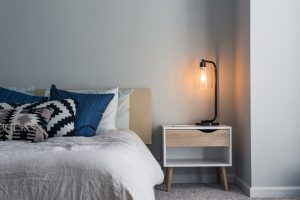
Your bedroom environment is the final piece of the puzzle. If your room is a sauna, no amount of tea will help you sleep.
Actionable Bedroom Modifications
- Swap Your Sheets: If you haven’t already, switch to 100% Linen or Bamboo viscose sheets. They are highly breathable and moisture-wicking. Cotton is okay, but it holds moisture (sweat).
- The Freezer Trick: Place a bowl of ice water on your nightstand. Drape a thin cotton bandana or face towel over it. The air that evaporates from the ice bowl cools the immediate micro-climate around your head.
- Blue Light Ban: This is non-negotiable in summer. Blue light from phones mimics daylight. In TCM, this tricks the Liver into thinking it is still noon, disrupting the smooth flow of Qi. Stop scrolling at 9:00 PM.
- Gravity Blanket Alternative: Heavy blankets are too hot, but the body craves that grounding weight. Use a “gravity eye mask” (weighted eye mask) instead. It stimulates the vagus nerve over the ocular points.
Common Questions
1. Is it true I should never sleep with the AC on?
Absolutely not! You can and should use air conditioning if it’s dangerously hot. The goal isn’t to suffer; it’s to be smart about it. The issue in TCM is “Wind-Cold” invasion. If you blast the AC and sleep directly in the draft, you can wake up with a stiff neck (what we call “落枕” or luò zhěn) or a summer cold. Set your thermostat to 76°F (24°C)—cool enough to sleep, but not freezing. Most importantly, ensure the airflow isn’t hitting your face or neck directly. Use a fan to circulate the air rather than pointing the vent at your bed.
2. Why do I wake up at 3 AM every summer?
This is one of the most common questions I get. In the Chinese Body Clock, 1:00 AM to 3:00 AM is the time of the Liver. The Liver is responsible for the smooth flow of Qi and Blood. If you are waking up during this window, it usually indicates that your Liver is “stagnant” or “overheated.” Summer heat exacerbates this because the Liver is closely tied to the Heart (Fire element). Stress, alcohol, spicy food, and repressed anger all contribute. Try the foot soak and PC-6 acupressure mentioned above. If it persists, consider adding a cooling herb like Gardenia (Zhi Zi) to your tea (consult a herbalist for dosage).
3. Can I exercise in the evening to tire myself out?
I advise caution here. In the summer, your Yang energy is already floating at the surface. High-intensity interval training (HIIT) or running at 8:00 PM pushes even more Yang to the surface, making you feel “wired” and hot. It raises your cortisol right when it should be dropping. Instead, opt for Yin Yoga or Tai Chi. These practices are slow, cooling, and downward-moving. If you must move vigorously, do it before 7:00 PM and allow at least 3 hours to cool down before bed.
The bottom line: Your summer evening reset isn’t about fighting the heat, but about flowing with it. By incorporating these five specific habits—cooling teas, grounding foot soaks, lighter foods, acupressure points, and a mindful bedroom environment—you create a sanctuary of stillness amidst the seasonal intensity. It’s about respecting your body’s need for rest, even when the sun stays up late.
This article is for educational purposes and reflects traditional wellness perspectives. It is not a substitute for professional medical advice, diagnosis, or treatment.